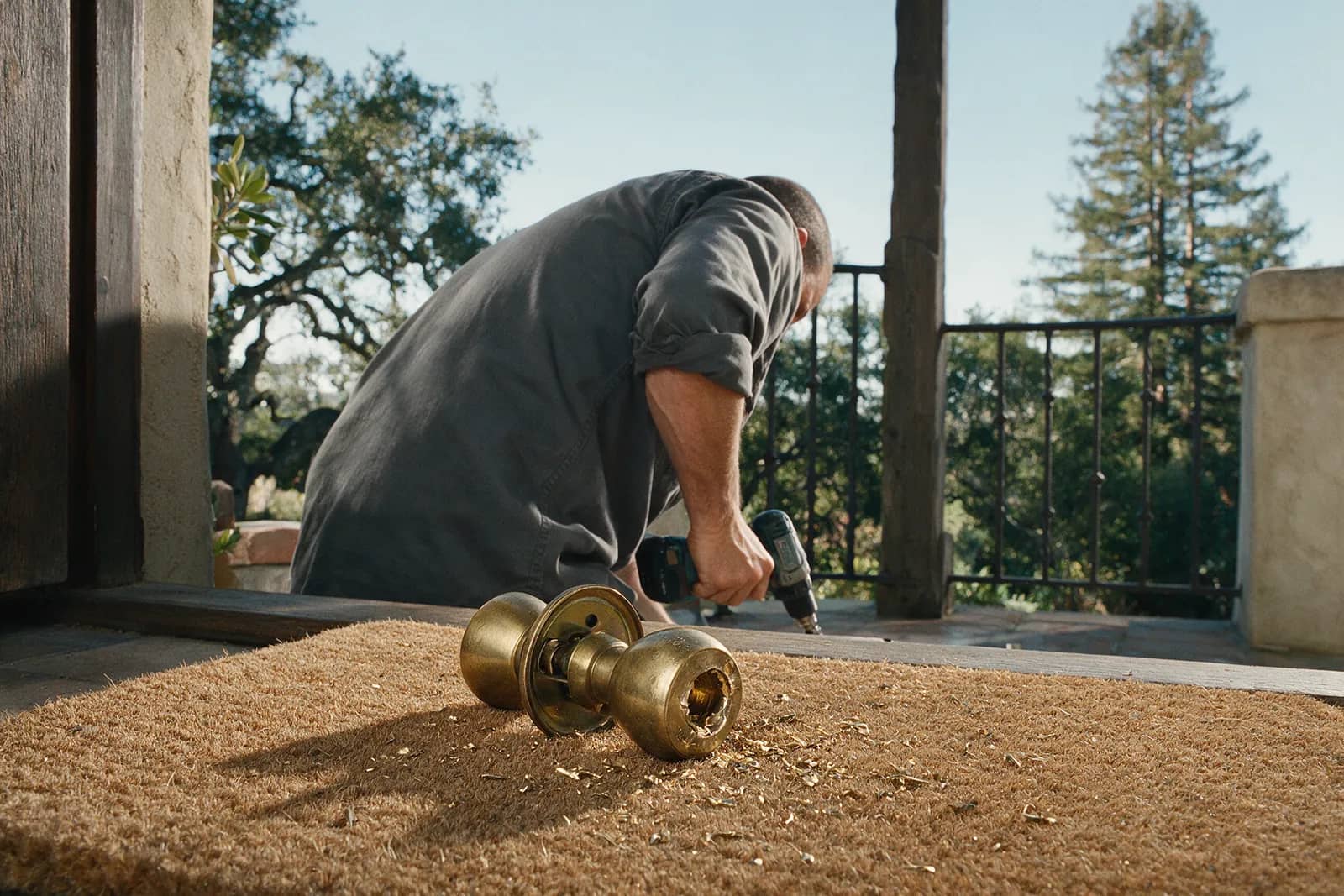
The door as it stands
The Craftsman houses on the slope south of Fourth Street were built with a front door meant to be seen from the porch. A wide slab of fir or oak, a glass panel in the upper third, sometimes with a beveled edge, and a knob set in bronze or brass with a plate that carries the knob, a keyhole for a bit key and a small thumb turn. Inside the edge of the door is a mortise case holding a latch and a warded bolt. Screwed to the inside face, a few inches above the knob, is a rim night latch that a father put on in the 1940s when the family stopped believing in the bit key.
Nearly everything on that door still works. The knob turns the latch and the door opens. The bit key, if it exists, still throws its bolt. The night latch holds the house at night. What the owner notices, forty years on, is that the knob has begun to wobble, the night latch needs a lift of the door to catch, and the bit key has been in a teacup on the sideboard since the 1970s. None of that is a reason to change the door. It is a reason to sort out which parts are doing a job.
Which parts are actually locking the house
The honest answer is the rim night latch and nothing else. The mortise bolt worked by the bit key is warded, and any bit key of the right size passes it; it is a latch with manners, not a lock. The night latch has a pin cylinder on the outside, and that cylinder is what a key from a pocket opens. It can be rekeyed at $26 to $43, which is the right first step for a house whose keys have gone out over four decades to a neighbor, a nephew and a man who fixed the furnace. A rekey changes nothing on the face of the door.
The night latch itself is the weak part. The 1940s pattern has a short bolt, a strike screwed into the door casing with three-quarter-inch screws, and a case that has been painted over so many times that the snib sticks. A modern rim deadbolt has the same footprint on the inside of the door, uses the same hole through the slab for its cylinder, and throws a bolt an inch into a strike with screws that reach the stud. That is a lock replacement at $119 to $319, and from the porch the door looks as it did in 1912.
What keeping the original means in practice
Keeping the original means the plate, the knobs, the keyhole and the thumb turn stay on the door and keep doing what they do. The wobble in the knob is a spindle, a square steel bar through the door that has worn at the set screw, and it is replaced with a new spindle and a set screw without the plate coming off. A latch that no longer springs back is a spring inside the mortise case, and the case comes out through the edge of the door, is cleaned and re-sprung, and goes back in. No new hole is bored through a 1912 slab with a glass panel; a lock that wants a two-and-an-eighth-inch bore does not belong on this door, and the technician will say so on the call.
Where the mortise case has cracked at the bolt or the latch has rounded off past use, a modern mortise case fits the same pocket behind the original plate and the knobs go back on. That is a replacement at $119 to $319, and the door does not know the difference. The bit key can be retired to the teacup for good, since the new case carries a real deadbolt worked from the night latch cylinder or from a thumb turn inside.
The parts that no longer exist
The difficulty with a 1912 door is not skill. It is that the spindle sizes, knob threads and plate spacings of that year were made by companies that stopped in the Depression. Some parts are still made in the old patterns, some are found at salvage, some are not to be had. The technician says at the door, with the plate off, which is which, and what can be done with what is there. A knob that will not tighten because its threads are stripped can be pinned to a new spindle. A plate that has cracked at a screw hole can be braced from behind. A missing rose can be turned or found.
What is not done is guessing. The figure named on the call covers the visit and the work that is likely from the owner's description, and if the plate comes off and the case is beyond saving, that is said before anything is changed, at a figure the owner agrees to. On most Gerstle Park doors the case is fine and the spindle and the springs are all that is needed.
The back door, the cellar and the gate
The front door is the one the owner loves and the back door is the one the house is entered through. A kitchen door onto the porch with a 1950s knob set and no deadbolt, a cellar door under the porch on a padlock, a wood gate onto the drive with a drop latch and no key. Those are where the house is actually vulnerable, and where the work of making it safer belongs. A deadbolt on the kitchen door is a replacement at $119 to $319. The cellar padlock is swapped. A keyed latch on the gate, on the house key, is one more cylinder.
Adult children who ask about their parent's house usually arrive wanting a new front door and leave with a rekeyed night latch, a deadbolt on the kitchen door and a gate that locks. That is the right order, and it comes to less than the door they had in mind.
A key for the caregiver without a keypad on the porch
The question that follows is how a caregiver, a cleaner or a visiting nurse gets in three mornings a week without a key going home in every bag. A keypad on a 1912 front door is not the answer, and it is not offered. The kitchen door is: a smart lock there at $185 to $469 gives each person a code that is retired the day they stop coming, with a mechanical key underneath it for the family. The front door stays as it was built and is used for guests.
Marin Lock & Key works to a promise called Named Before the Van Leaves: one full figure named on the call, covering the visit, the labor, the parts and the drive; the technician's name and a thirty-minute window by text before the van leaves the yard, and a call from the gate; the door opened without damage first, with drilling only after you agree, at the same figure; card or tap at the door, an itemized receipt by email, and a written line for an insurer or a family member managing the house if one is needed. Arrival to Gerstle Park is about seventeen minutes, and the streets are quiet enough that the van is heard before it is seen.
Quick answers
Can the original knob set on a 1912 door stay if the lock is replaced?+
Yes. The plate, knobs, keyhole and thumb turn stay on the door. A worn spindle or spring is replaced behind them, and where the mortise case is beyond saving a modern case fits the same pocket behind the original plate at $119 to $319.
Is the bit key lock on the front door doing anything?+
Very little. A warded bolt is passed by any bit key of the right size. The rim night latch on the inside face is the lock that holds the house, and its cylinder is rekeyed at $26 to $43 or the latch is replaced with a modern rim deadbolt of the same footprint.
How does a caregiver get in without a keypad on the front door?+
A smart lock on the kitchen door at $185 to $469, with a code for each person that is retired when they stop coming and a mechanical key under it for the family. The front door is left as it was built.
Need it handled rather than read about?
(628) 251-8459More guides